Private Label Handbag Organizers & Dust Covers: OEM Guide
VIVAN EDITORIAL ·
Looking for a reliable factory for custom handbag inserts, shaping pillows, and dust covers? VIVAN (Weiwan) offers small-batch private label OEM/ODM services.
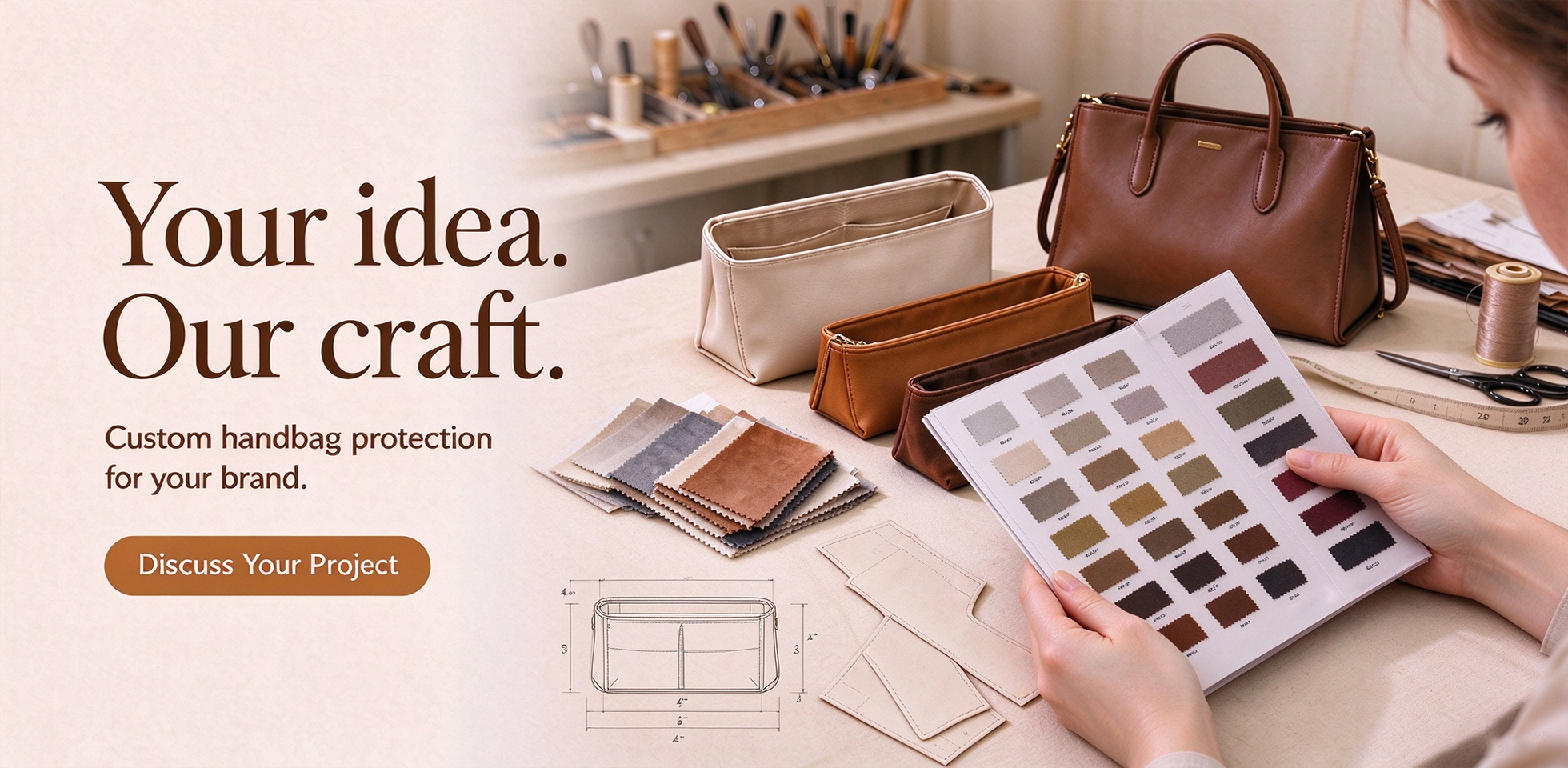
The Private Label OEM Guide for Luxury Handbag Care: Inserts, Pillows & Dust Covers
For luxury resellers, independent handbag designers and premium boutiques, a branded bag care collection can extend the customer experience beyond the purchase of a handbag. An organizer, storage pillow or dust cover gives customers a practical reason to keep using an item carrying your brand name. The commercial value depends on product quality, pricing and how well the collection meets your customers' needs.
Choosing a manufacturing partner starts with the details: usable interior dimensions, contact materials, seam construction and a sample that can be reviewed with the intended bag. VIVAN (Weiwan) supports private label development for handbag organizer inserts, shaping pillows, dust covers and accessories. This guide explains what to prepare for a quotation and how to move from a brief to an approved production specification.
1. Build your private label product matrix
A coordinated collection does not need to launch with every accessory. Start with the products that match the way your customers carry, store or receive their bags, then discuss whether additional items belong in a later order.
- Handbag organizer inserts: Discuss interior measurements, pockets, structure and inward-facing seams. The insert should fit without forcing the sides or closure. No construction guarantees prevention of all pressure marks; review contact areas and fit with a sample.
- Handbag shaping pillows: Specify the shell, fill level and dimensions for gentle support during storage. Avoid overfilling. Moisture-control performance must not be assumed from a fabric name.
- Handbag dust covers: Discuss fabric feel, composition, overall dimensions and the opening style for boutique packaging or standalone retail. Satin, cotton and other requested materials are subject to project confirmation.
- Straps, hardware and protection projects: Share the intended function and attachment details. Decorative chains and D-ring connectors are not automatically protective covers, and carrying compatibility requires confirmation.
2. Discuss MOQ before planning a launch
The minimum order quantity for a private label project depends on construction, material sourcing, artwork, branding method and packaging. Treat the following quantities as useful inquiry bands, not a universal price list or a guaranteed acceptance policy.
| Quantity to discuss | Typical project brief | Details to confirm |
|---|---|---|
| 1 piece | An individual custom-fit inquiry or a proposed first sample | Feasibility, development work and sample charge |
| 2–10 pieces | Prototype review and material or color comparison | Sample variations, artwork and delivery arrangements |
| 11–50 pieces | A proposed limited release or VIP gifting project | Material minimums, branding method and unit cost |
| 51–200+ pieces | A proposed commercial private label order | Final quantities by size and color, packaging and production schedule |
Send the expected quantity for each style, size and color rather than just a combined total. This helps our team evaluate material requirements and the proposed production plan. Confirm MOQ, sampling terms and pricing in the quotation before promising a launch date to your customers.
3. Explore four branding applications
Branding should be reviewed together with the base material. The 36-number photographed color card is a useful reference for discussing appearance, but a color number does not certify material composition, stock availability or suitability for a particular printing process.
- Printed logo. Discuss artwork, ink color, placement and the selected fabric. Confirm the appearance and durability requirements on a sample rather than assuming every print method works on every surface.
- Woven or sewn brand label. Agree the label dimensions, position and seam placement. Check that the label and its edges are appropriate for the intended contact area.
- Embossed or debossed mark. Explore a textured mark on a suitable patch or component. Material choice, artwork detail and the application method require sample review.
- Foil logo and custom packaging. Discuss compatible packaging surfaces and the desired finish. Confirm packaging dimensions, artwork and protection during delivery as part of the specification.
View our illustrative logo application examples to start the discussion. They demonstrate possible approaches, not identical results on all fabrics.
4. Follow a three-step development process
Step 1: Share your brief
Send bag models or measured interior dimensions, product references, logo artwork, preferred color numbers and estimated quantities. Include the delivery country and your required date. If you are developing an accessory for your own handbag design, provide the relevant construction details and explain how the accessory will be used.
Step 2: Develop and review the sample
Agree the sampling scope, charges and schedule. Review material feel, fit, pocket layout, seam finish, logo placement and packaging. Courier arrangements and charges are confirmed for the project. Record requested changes clearly and approve the final sample and written specification before proceeding to production.
Step 3: Confirm production and delivery
Once the order details are agreed, production follows the approved specification through cutting, sewing and inspection. Confirm quantities by variant, inspection requirements, packaging, delivery address and shipping terms. Lead times and available carriers depend on the order and destination; worldwide service does not mean every destination or deadline can be guaranteed.
Questions from boutique and brand buyers
Can I start with a small collection?
Yes, you can propose a small-batch project. Send the product and quantity breakdown so we can assess feasibility and confirm minimum quantities. A sampling inquiry is not the same as approval of a production order.
Can one color be used across inserts, pillows and covers?
Discuss a coordinated appearance, but do not assume different fabrics produce an identical shade or finish. Compare physical samples under consistent lighting and approve the combination for your collection.
What determines the sampling and production lead time?
Design complexity, materials, artwork, revisions and the current production schedule all matter. Ask for a project-specific schedule and allow time for physical sample review before committing to a retail launch.
Start your private label project
Use the consultation page or email janicetian@baodingweiwan.com. You can also contact WhatsApp +86 18730922465. Include your product references, measurements, color numbers, quantity and delivery destination so we can begin with a useful brief.
VIVAN is an independent supplier. Any references to luxury handbag brands identify intended bag styles and do not imply affiliation or endorsement. Product fit and material suitability must be confirmed for the intended bag.